Water fire extinguishers are the original form of portable fire extinguisher and remain a common choice for tackling Class A fires involving combustible solids.
Contents
- 1 Where Can Water Fire Extinguishers Be Used?
- 2 Where Can Water Fire Extinguishers Not Be Used?
- 3 How Do You Identify a Water Fire Extinguisher?
- 4 What Are Water Fire Extinguishers Also Known As?
- 5 How Do Water Fire Extinguishers Work?
- 6 Water Spray vs Water Mist Fire Extinguishers
- 7 What Are the Pros and Cons?
- 8 Who Needs Water Fire Extinguishers?
- 9 How Do You Use A Water Fire Extinguisher?
- 10 Water Fire Extinguishers and UK Fire Safety Law
- 11 Our Services
Where Can Water Fire Extinguishers Be Used?
A water fire extinguisher will only work in situations where the fire involves flammable solids. These are often known as Class A fires and include solids such as textiles, paper, and wood.
Where Can Water Fire Extinguishers Not Be Used?
 There are many cases where a water fire extinguisher cannot be used. These are as follows:
- Fires involving live electrical equipment. Water extinguishers must not be used unless the electrical supply has been isolated. Some water mist extinguishers are specifically tested for limited electrical use — standard water extinguishers are not.
- Class B fires; involving flammable liquids such as paint, petrol, or diesel
- Class C fires; involving flammable gases like butane or methane
- Class F fires; cooking fires, where oil or grease is present, such as a chip pan fire
How Do You Identify a Water Fire Extinguisher?
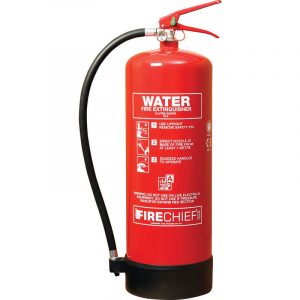
- Water fire extinguishers are red in colour, with the word “WATER” clearly displayed on the body of the extinguisher in accordance with UK standards. Some modern water extinguishers may also include additional markings such as “Water Spray” or “Water Mist”
- There should be an ID sign close by which will read – WATER EXTINGUISHER
What Are Water Fire Extinguishers Also Known As?
A water fire extinguisher can also be known as a Class A extinguisher.
How Do Water Fire Extinguishers Work?
Water has a significant cooling impact. When the water is directed at the flames, it brings the overall temperature down and doesn’t allow the fire to burn.
Water Spray vs Water Mist Fire Extinguishers
Traditional water spray extinguishers are designed for Class A fires involving combustible solids such as wood, paper, and textiles.
Water mist extinguishers are a more modern variation. They produce ultra-fine droplets that cool the fire and reduce oxygen at the flame surface. Some water mist extinguishers are tested and certified for safe use on live electrical equipment up to a specified voltage.
Always check the extinguisher label and manufacturer certification to confirm its approved uses.
What Are the Pros and Cons?
Pros
There are two main pros of using a water fire extinguisher. Firstly, there is not a negative environmental impact. Secondly, the fire is put out quickly. This is because the cooling effect that is caused when the extinguisher is in use is rapid.
Cons
This fire extinguisher type has several cons, as follows:
- Will only work on one class of fire
- Can be dangerous if the water reaches electrical equipment
Who Needs Water Fire Extinguishers?
In environments where there are large quantities of combustible material, having a water extinguisher can be useful. This is often in addition to another extinguisher, such as a foam fire extinguisher, being present. Such premises may include:
- Warehouses
- Paper mills
- Textile factories
- Storage units
- Schools
- Offices (low electrical risk areas)
- Libraries
How Do You Use A Water Fire Extinguisher?
Safe use of a water fire extinguisher includes the following steps:
- Remove the safety pin to break the anti-tamper seal and stand at a safe distance
- Have the nozzle pointed towards the base of the fire and then squeeze the handle
- Continue to spray until the fire is completely out
Water Fire Extinguishers and UK Fire Safety Law
UK fire safety legislation does not prescribe specific extinguisher types. Under the Regulatory Reform (Fire Safety) Order 2005, the Responsible Person must provide appropriate fire-fighting equipment based on the findings of a fire risk assessment.
British Standard BS 5306-8 provides recognised guidance on the selection and positioning of water fire extinguishers.
Our Services
If you need fire extinguisher commissioning, servicing and maintenance, our accredited consultants will attend your sites at a time convenient to you. Contact us today to arrange a visit and decide on the future course of action.