Fire door self-closers are a critical component of fire safety in UK buildings. In most commercial premises and communal residential buildings, fire doors are required to be self-closing to maintain compartmentation and protect escape routes. A fire door is only effective if it closes fully and latches securely after every use. Without a functioning self-closing device, even a certified FD30 or FD60 door may fail to perform as intended during a fire.
This guide explains when fire door self-closers are required, what UK regulations say, the different types of closers available, and the most common reasons they fail.
Contents
- 1 Are Fire Door Self-Closers Required in the UK?
- 2 Why Self-Closers Are Critical to Fire Door Performance
- 3 Types of Fire Door Self-Closers
- 4 Common Fire Door Self-Closer Failures
- 5 Do All Fire Doors Need Self-Closers?
- 6 How Self-Closers Are Checked During Inspection
- 7 Can Fire Door Closers Be Repaired?
- 8 Why Self-Closer Maintenance Matters
- 9 Quick Summary
- 10 Conclusion
- 11 Frequently Asked Questions
- 11.1 Do all fire doors need self-closers in the UK?
- 11.2 Are fire door self-closers a legal requirement?
- 11.3 What happens if a fire door does not self-close?
- 11.4 Can you disconnect a fire door closer?
- 11.5 How are fire door closers checked during inspections?
- 11.6 Can a faulty fire door closer be repaired?
Are Fire Door Self-Closers Required in the UK?
In most commercial and multi-occupied residential buildings, fire doors are required to be self-closing. The purpose is simple: if a fire breaks out, doors must shut automatically to restrict the spread of smoke and flames.
Under the Regulatory Reform (Fire Safety) Order 2005, fire safety measures must be properly maintained. A fire door that does not self-close may not meet this requirement.
Guidance within Approved Document B of the Building Regulations also expects fire-resisting doors protecting escape routes and compartmentation to be fitted with suitable self-closing devices.
In higher-risk residential buildings in England, additional inspection duties apply under the Fire Safety (England) Regulations 2022, which specifically reference checks on flat entrance doors and communal fire doors.
Why Self-Closers Are Critical to Fire Door Performance
Fire doors are designed and tested as complete assemblies. The self-closing device ensures the door returns to the closed position after use, maintaining compartmentation.
If a fire door is left open, even temporarily, it can:
- Allow smoke to spread rapidly through corridors and stairwells
- Compromise escape routes
- Increase risk to occupants and firefighters
- Undermine the building’s passive fire protection strategy
Many fire door inspection failures arise not from the door leaf itself, but from malfunctioning or disconnected self-closers.
Types of Fire Door Self-Closers
Most fire door self-closing devices in the UK are tested to BS EN 1154, which specifies performance requirements for controlled door closing devices.
Several types of closing devices are commonly used in UK buildings:
1. Overhead Surface-Mounted Closers
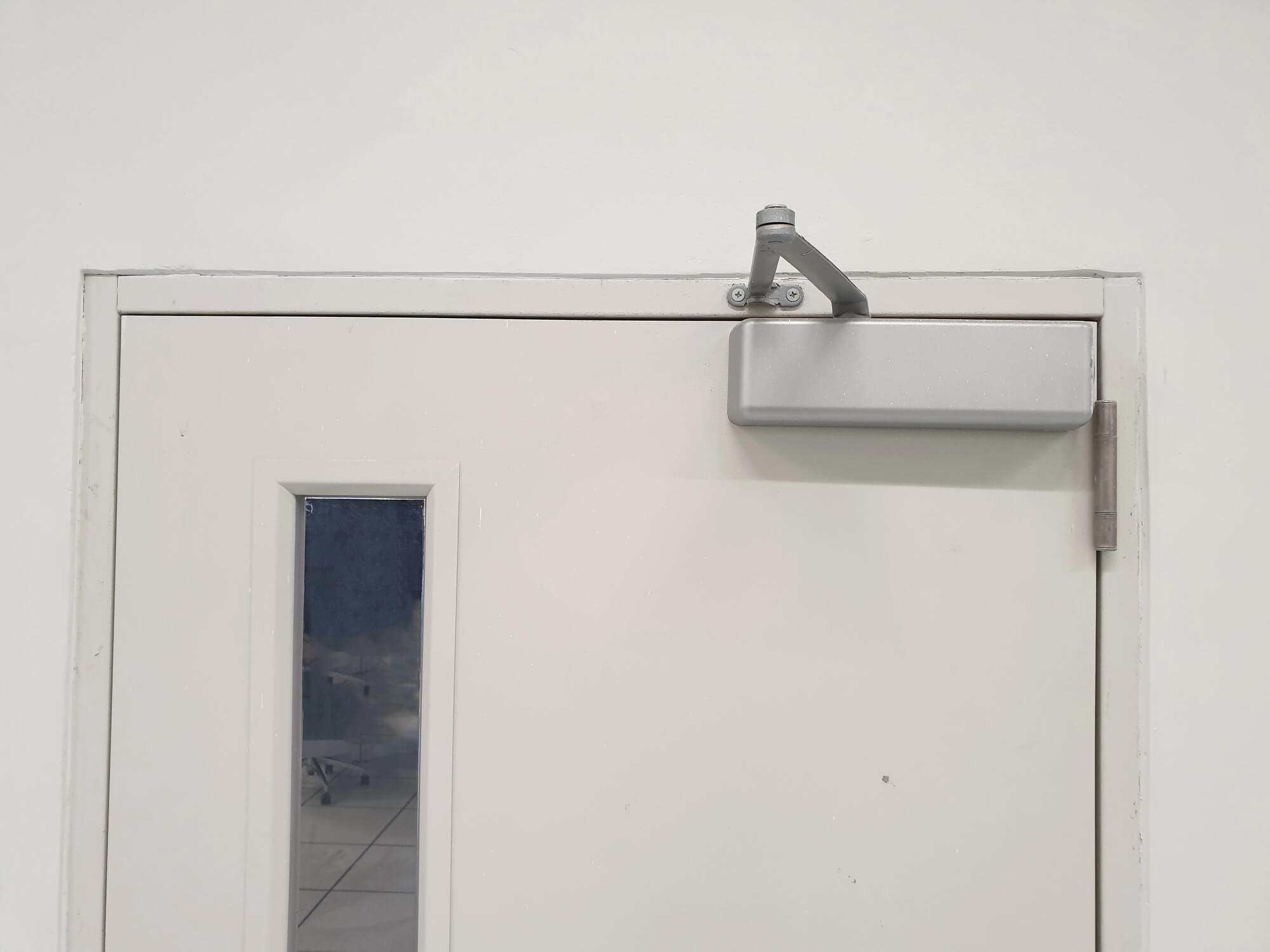
The most common type. These hydraulic devices are visible above the door and use an arm mechanism to control closing speed.
2. Concealed Closers
Fitted within the door leaf or frame. These provide a cleaner aesthetic but must still be fire-rated and correctly installed.
3. Floor Spring Closers
Often used with glazed doors or heavy doors. Installed within the floor beneath the door.
4. Electromagnetic Hold-Open Devices
These allow doors to remain open during normal use but automatically release upon activation of the fire alarm system.
Where hold-open devices are used, they should be correctly interfaced with the fire alarm system in accordance with relevant standards such as BS 7273-4.
Each type must be compatible with the fire door’s certification.
Common Fire Door Self-Closer Failures
Self-closers are one of the most frequently identified defects during inspections, often appearing within reports highlighting common fire door defects.
1. Door Fails to Fully Close
The door may close partially but fail to latch. This is often caused by incorrect adjustment, wear, or misalignment.
2. Hydraulic Fluid Leakage
Oil leakage from the closer body reduces closing control and effectiveness.
3. Closers Disconnected or Removed
In some buildings, closers are deliberately disconnected because occupants find them inconvenient.
4. Incorrect Closer Strength
Closers are rated by power size (e.g., EN 2–6). An underspecified closer may not overcome air pressure or door weight.
5. Damage or Tampering
Arms bent, screws missing, or components damaged through misuse.
6. Slamming or Excessive Closing Speed
Closers set too aggressively can cause doors to slam, leading to damage, seal wear and occupant frustration.
Do All Fire Doors Need Self-Closers?
In most commercial premises and communal residential areas, yes. Fire doors forming part of protected escape routes or compartment walls are generally expected to be self-closing.
However, fire doors within single private dwellings (such as internal doors inside a flat or house) may not require the same specification unless dictated by building design or loft conversion requirements.
Requirements should always be confirmed through fire risk assessment, Approved Document B guidance and building-specific design criteria.
How Self-Closers Are Checked During Inspection
During structured fire door inspections and surveys, self-closers are assessed to ensure that:
- The door closes fully from any open position
- The latch engages correctly
- The closer is securely fixed
- No leakage or visible damage is present
- The closing speed is appropriately controlled
Failure in any of these areas may require adjustment, repair or replacement.
Simple Functional Test
A basic test involves opening the door fully and allowing it to close without assistance. The door should close smoothly, latch securely and not slam. It should also close from a partially open position (e.g., 5 degrees).
Can Fire Door Closers Be Repaired?
Minor issues such as adjustment settings or loose fixings can often be corrected. However, hydraulic leakage, mechanical failure or incorrect specification usually requires replacement.
Any replacement closer must be fire-rated and compatible with the door’s certification.
Why Self-Closer Maintenance Matters
Self-closing devices experience high levels of daily use, especially in communal residential blocks, offices, schools and healthcare premises.
Regular checks help prevent:
- Non-compliance during audits
- Smoke spread through propped-open doors
- Enforcement action
- Insurance concerns
Self-closers should be considered part of ongoing fire door maintenance, not a “fit and forget” component.
Quick Summary
- Most commercial and communal fire doors must be self-closing.
- Self-closers should be tested to BS EN 1154.
- Hold-open devices must release upon fire alarm activation.
- Doors must close fully and latch securely from any position.
- Faulty closers are a common inspection failure.
Conclusion
Fire door self-closers are not optional hardware — they are fundamental to maintaining compartmentation and protecting escape routes.
Common failures such as leakage, incorrect adjustment, removal or poor specification are frequently identified during inspections. Ensuring that closers are correctly installed, maintained and compatible with the door’s fire rating is a fundamental part of fire door compliance in UK buildings.
Frequently Asked Questions
Do all fire doors need self-closers in the UK?
In most commercial premises and communal residential buildings, fire doors are required to be self-closing to maintain compartmentation. Requirements vary depending on building type and risk assessment outcomes. Flat entrance doors in purpose-built blocks are generally expected to be self-closing.
Are fire door self-closers a legal requirement?
While legislation does not always list specific hardware components, UK fire safety law requires fire protection measures to be properly maintained. A fire door that does not close automatically may fail to meet this duty under the Regulatory Reform (Fire Safety) Order 2005.
What happens if a fire door does not self-close?
If a fire door fails to close fully and latch, it may allow smoke and fire to spread rapidly through a building. This can compromise escape routes and may result in non-compliance during inspections.
Can you disconnect a fire door closer?
No. Disconnecting or disabling a self-closer can undermine fire safety and may breach fire safety duties. If occupants find a closer difficult to use, it should be adjusted or replaced with a compliant alternative rather than removed.
How are fire door closers checked during inspections?
Inspectors assess whether the door closes fully from any open position, latches correctly, and whether the closer is securely fixed and free from leakage or damage. These checks form part of structured fire door inspections.
Can a faulty fire door closer be repaired?
Minor issues such as loose fixings or adjustment settings may be corrected. However, hydraulic leakage or mechanical failure usually requires replacement with a compatible, fire-rated closer.