Fire door compliance in blocks of flats is not optional — it is a legal requirement and a critical life-safety measure.
In multi-occupied residential buildings, fire doors form part of the building’s compartmentation strategy. They are designed to contain fire and smoke, protect escape routes, and give residents vital time to evacuate safely.
At Fire Risk Assessment Network, we support property owners, organisations and Responsible Persons across the UK with professional fire door inspections and fire door surveys for blocks of flats, ensuring compliance with current UK legislation and recognised industry standards.
If you manage a residential block, this guide explains exactly what the law requires, what doors must comply, how often they must be inspected, and how to demonstrate defensible compliance.
Contents
- 1 Quick Answer: What Does Fire Door Compliance Mean for Blocks of Flats?
- 2 UK Legal Requirements for Fire Door Compliance in Blocks of Flats
- 3 What Fire Doors Are Required in Blocks of Flats?
- 4 Inspection Requirements for Blocks of Flats
- 5 Common Compliance Issues in Blocks of Flats
- 6 Fire Door Inspections & Fire Door Surveys for Blocks of Flats
- 7 How Fire Door Compliance Links to Your Fire Risk Assessment (FRA)
- 8 Frequently Asked Questions
- 8.1 Who is legally responsible for fire doors in a block of flats?
- 8.2 Are flat entrance doors required to be fire doors?
- 8.3 How often must fire doors be inspected in blocks of flats?
- 8.4 What is checked during a fire door inspection?
- 8.5 Do older blocks of flats need to upgrade all fire doors?
- 8.6 What happens if fire doors are not compliant?
- 8.7 Do managing agents need a professional fire door survey?
Quick Answer: What Does Fire Door Compliance Mean for Blocks of Flats?
Fire door compliance in blocks of flats means ensuring that:
- Flat entrance doors provide appropriate fire and smoke resistance (typically FD30S)
- Communal fire doors are maintained in effective working order
- Quarterly and annual inspections are carried out where required
- Defects are recorded and remedial action is taken
- Residents are provided with fire door safety information
For buildings over 11 metres in height, inspection duties under the Fire Safety (England) Regulations 2022 apply. Compliance must be demonstrable and documented.
These duties apply to multi-occupied residential buildings containing two or more domestic premises, where flats share communal areas such as corridors, stairwells or lobbies.
UK Legal Requirements for Fire Door Compliance in Blocks of Flats
Fire door compliance in residential buildings is governed by a combination of fire safety and building legislation.
1. Regulatory Reform (Fire Safety) Order 2005
The Fire Safety Order applies to the communal areas of blocks of flats. It requires the Responsible Person (often the landlord, managing agent or freeholder) to:
- Carry out a suitable and sufficient fire risk assessment
- Maintain general fire precautions, including fire doors
- Ensure fire safety measures remain effective
Fire doors in communal corridors, stairwells and flat entrances form part of these “general fire precautions”.
For a broader overview of UK legal requirements, see our guide to fire door regulations.
2. Fire Safety (England) Regulations 2022
These regulations introduced specific duties for multi-occupied residential buildings.
The regulations apply to buildings containing two or more domestic premises. Additional inspection duties apply where the building is over 11 metres in height. Higher-risk residential buildings over 18 metres are subject to further oversight under building safety legislation.
For buildings over 11 metres in height, Responsible Persons must:
- Undertake quarterly checks of communal fire doors
- Undertake annual checks of flat entrance doors (on a best endeavours basis)
- Provide residents with information about the importance of fire doors
This has significantly increased enforcement focus on flat entrance doors in blocks of flats.
3. Building Regulations Approved Document B
Approved Document B sets out guidance on fire resistance, compartmentation and door ratings. It underpins the specification of:
- FD30 / FD30S fire doors
- FD60 doors where required
- Smoke seals and self-closing devices
While primarily a design document, it influences expectations for existing buildings, especially during refurbishment.
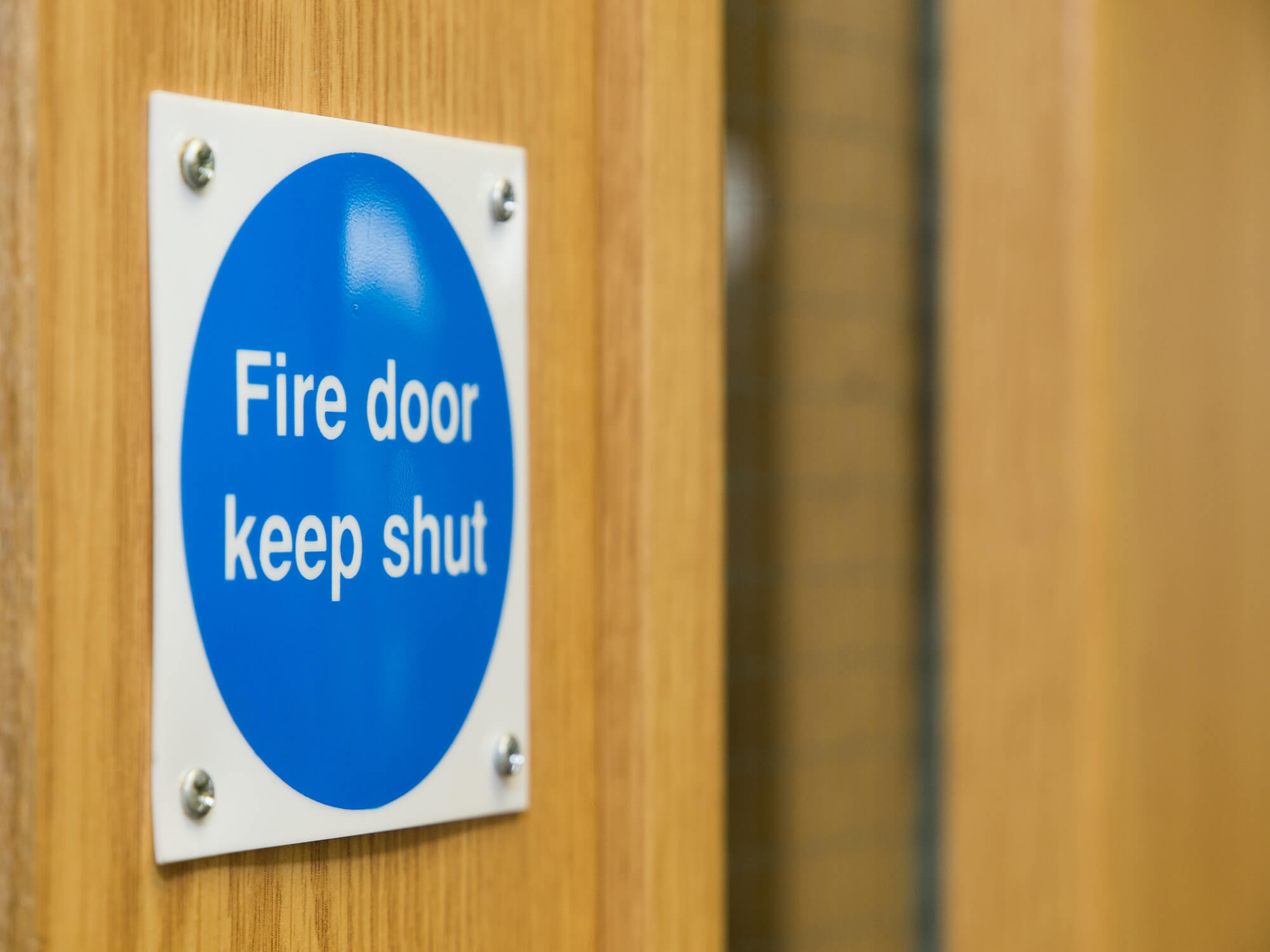
What Fire Doors Are Required in Blocks of Flats?
Understanding where fire doors are required is central to compliance.
Flat Entrance Doors
Flat entrance doors are critical. They separate private dwellings from communal escape routes.
Although flat entrance doors serve private dwellings, they form part of the fire protection strategy for the building’s common parts. Their performance directly affects the safety of communal escape routes.
In most blocks of flats, entrance doors must:
- Provide at least FD30S fire resistance (30 minutes + smoke control). The “S” designation indicates that the door provides protection against cold smoke leakage at ambient temperatures, helping prevent smoke spread into escape routes during the early stages of a fire.
- Be fitted with intumescent strips and cold smoke seals
- Have an effective self-closing device
- Close fully into the frame
If compromised, these doors can allow fire and smoke to enter protected corridors and stairwells.
Communal Fire Doors
Doors in:
- Stair enclosures
- Protected corridors
- Lobbies
- Plant rooms
must match the building’s fire strategy and compartmentation design.
In some higher-risk or taller buildings, FD60 doors may be required depending on the fire strategy.
Internal Flat Doors
In certain layouts — particularly older maisonettes or flats with extended travel distances — internal doors within flats may also need to be fire-resisting. This is determined by risk assessment and building design.
Inspection Requirements for Blocks of Flats
The Fire Safety (England) Regulations 2022 changed expectations around inspections.
Buildings Over 11 Metres
Responsible Persons must:
- Inspect communal fire doors at least every three months
- Inspect flat entrance doors at least annually (best endeavours)
- Keep records of inspections and actions taken
The term “best endeavours” means Responsible Persons must make reasonable and documented attempts to gain access to inspect flat entrance doors. This may include written requests, follow-up communication and keeping records of attempted access.
Failure to demonstrate inspection regimes is now a common enforcement trigger.
Responsible Persons must also provide residents with information about the importance of fire doors, including keeping self-closing devices operational and not altering doors. This information duty forms part of overall compliance expectations.
What Is Checked During a Fire Door Inspection?
A competent fire door inspection should assess:
- Door leaf condition (damage, warping, unauthorised alterations)
- Gaps around the frame
- Intumescent and smoke seals
- Hinges and ironmongery
- Self-closer operation
- Glazing integrity (if present)
- Certification markings (where available)
Fire doors are a complete doorset system. Replacing components incorrectly can invalidate fire performance.
Common Compliance Issues in Blocks of Flats
Across the UK, the most common failures include:
- Residents removing or disabling self-closers
- Excessive gaps around door edges
- Letterplates or cat flaps installed without fire protection
- Damaged seals
- Poor historical record-keeping
Many buildings constructed before modern regulations rely on risk-assessed tolerances rather than new-build standards. This requires professional judgement — not guesswork.
Enforcement, Liability & Insurance Risk
Non-compliant fire doors can:
- Undermine compartmentation
- Compromise stay-put strategies
- Invalidate insurance
- Lead to enforcement notices or prosecution
In many purpose-built blocks of flats, the fire strategy is based on a “stay-put” principle. This relies heavily on effective compartmentation and properly functioning fire doors. Non-compliance can undermine that strategy and increase life safety risk.
Fire and Rescue Authorities have powers to issue enforcement notices, alteration notices and prohibition notices where fire safety duties are not met. Inspection records are increasingly requested during audits and investigations.
Demonstrating a structured inspection regime is essential for defensible compliance.
Fire Door Inspections & Fire Door Surveys for Blocks of Flats
At Fire Risk Assessment Network, we carry out professional fire door inspections and fire door surveys across the UK. Our surveys are specifically designed to support fire door compliance in blocks of flats and multi-occupied residential buildings.
Our inspections are carried out by competent fire safety professionals in accordance with current UK guidance and recognised industry best practice. Reports are clear, structured and suitable for demonstrating compliance to enforcing authorities and insurers.
Our service supports managing agents, freeholders, housing providers and other Responsible Persons responsible for blocks of flats and multi-occupied residential buildings.
Our Fire Door Survey Service Includes:
- Full doorset inspections in line with current UK guidance
- Flat entrance and communal door checks
- Clear defect categorisation
- Photographic evidence
- Remedial action schedules
- Compliance-focused reporting
- Integration with existing fire risk assessments
We provide proportionate, practical advice — not unnecessary replacement recommendations.
If you manage a portfolio of blocks, we can also assist with structured inspection programmes aligned with quarterly and annual requirements.
How Fire Door Compliance Links to Your Fire Risk Assessment (FRA)
Fire doors are assessed within the broader context of a fire risk assessment (FRA), particularly in relation to compartmentation and means of escape.
A fire door survey may:
- Support your existing fire risk assessment
- Identify changes since the last FRA
- Provide evidence for insurers or enforcement authorities
- Inform capital works planning
We frequently work alongside Responsible Persons to integrate door inspections into wider compliance strategies.
Frequently Asked Questions
Who is legally responsible for fire doors in a block of flats?
In most blocks of flats, the Responsible Person under the Regulatory Reform (Fire Safety) Order 2005 is responsible for fire doors in communal areas and, in many cases, flat entrance doors.
This is usually:
- The freeholder
- A managing agent acting on behalf of the freeholder
- A Right to Manage (RTM) company
- A housing association or local authority
Lease arrangements can affect responsibility for flat entrance doors, so this should be clarified. However, compliance duties under fire safety legislation still apply to the Responsible Person for the building’s common parts.
Are flat entrance doors required to be fire doors?
Yes. Where flats open onto a communal corridor or protected stairwell, entrance doors are typically required to provide FD30S fire resistance (30 minutes fire resistance plus smoke control).
The exact requirement depends on:
- The building’s height
- The fire strategy
- The original building design
- Any subsequent refurbishment
If you are unsure whether your flat entrance doors are compliant, a professional fire door survey should be undertaken.
How often must fire doors be inspected in blocks of flats?
Under the Fire Safety (England) Regulations 2022:
- Communal fire doors in buildings over 11 metres must be inspected at least every 3 months.
- Flat entrance doors must be checked at least annually on a “best endeavours” basis.
Inspection frequency may be increased depending on risk profile, building condition, or findings from previous surveys.
A structured inspection regime with documented records is essential for defensible compliance.
What is checked during a fire door inspection?
A competent fire door inspection will assess the full doorset, including:
- Door leaf condition
- Frame and gap tolerances
- Intumescent strips and smoke seals
- Hinges and ironmongery
- Self-closing device performance
- Glazing (if present)
- Evidence of unauthorised alterations
The inspection determines whether the door is:
- Serviceable
- Requiring adjustment
- Requiring repair
- Or needing replacement
Professional reporting should clearly categorise defects and outline proportionate remedial actions.
For a detailed breakdown of what is checked in the process, see our guide to what is checked during a fire door inspection.
Do older blocks of flats need to upgrade all fire doors?
Not automatically.
Existing fire doors may remain acceptable if they provide adequate fire resistance within the building’s overall fire strategy. However, damage, poor maintenance, or unauthorised modifications can render a door non-compliant.
A fire door survey helps determine whether replacement is necessary or whether repair and adjustment are sufficient.
What happens if fire doors are not compliant?
Non-compliant fire doors can:
- Compromise compartmentation
- Allow smoke to enter escape routes
- Undermine stay-put strategies
- Lead to enforcement action
- Invalidate insurance policies
Fire and Rescue Authorities increasingly expect to see inspection records and maintenance programmes in place.
Do managing agents need a professional fire door survey?
While legislation does not prescribe a specific survey format, Responsible Persons must demonstrate that fire precautions are maintained effectively.
For blocks of flats, best practice is to commission a professional fire door inspection carried out by a competent person and supported by documented reporting.