Not all premises present the same level of fire risk, which is why fire alarm systems in the UK are designed and categorised to suit different building types, uses, and occupancy levels.
Under UK fire safety law, the Responsible Person must ensure that any fire detection and alarm system installed is appropriate for the premises, based on the findings of a suitable and sufficient fire risk assessment.
Fire alarm systems are designed, installed, and maintained in accordance with British Standard BS 5839, which provides clear guidance on both the grade of system required and the category of protection it provides.
These standards are widely used by fire alarm designers, installers, housing associations, commercial property owners, local authorities, and enforcing bodies. Their purpose is twofold:
To protect life by providing early warning and safe evacuation
To protect property and support business continuity
Quick Answer: What Are Fire Alarm Categories?
Fire alarm categories describe the level and purpose of fire detection and warning in a building. In non-domestic premises, BS 5839-1:2025 uses life protection categories such as M, L1, L2, L3, L4 and L5, and property protection categories such as P1 and P2. Domestic premises use grades and categories under BS 5839-6:2019+A1:2020.
The correct category should be based on the fire risk assessment, building layout, escape routes, occupancy, sleeping risk and business continuity needs.
What Are Fire Alarm Grades?
Fire alarm grades describe the type and quality of system installed, primarily relating to power supplies, system complexity, and control equipment.
Grades range from A (the highest) to F (the lowest). Domestic premises typically use Grades D–F, while most commercial and higher-risk premises require Grades A–C.
Fire Alarm Grades Explained
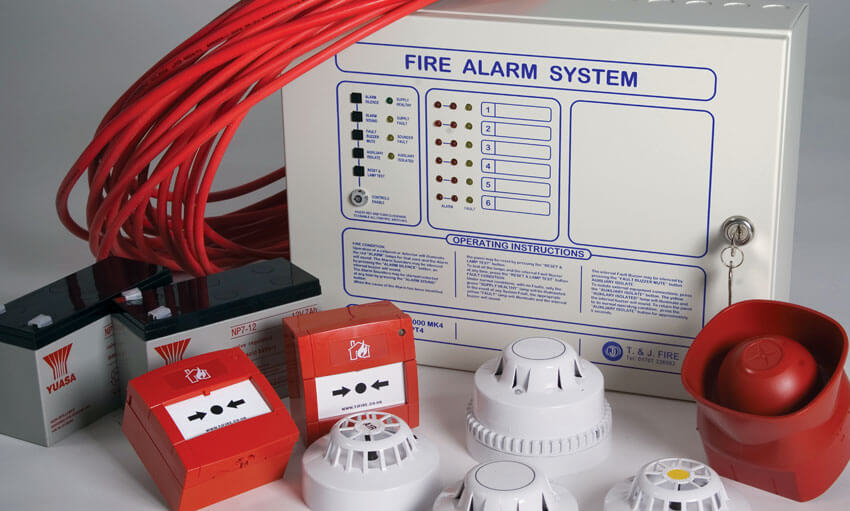
- Grade A: A fully featured fire alarm system incorporating automatic detectors, manual call points, alarm sounders, and a central control and indicating panel. These systems must comply with BS 5839-1 (commercial premises) or BS 5839-6 (domestic premises where applicable) and use components conforming to BS EN 54 standards. Grade A systems are standard for most commercial, industrial, and multi-occupied premises.
- Grade C: A system comprising detectors and sounders interconnected to a common power supply, typically mains powered with a standby supply, but without a full control panel.
- Grade D1: Mains-powered detectors with a tamper-proof battery backup.
- Grade D2: Mains-powered detectors with a user-replaceable battery backup.
- Grade F1: Stand-alone battery-powered detectors with sealed, tamper-proof batteries.
- Grade F2: Stand-alone battery-powered detectors with user-replaceable batteries.
Most commercial premises require a Grade A fire alarm system, determined through fire risk assessment.
What Are Fire Alarm Categories?
While grades describe the system type, fire alarm categories define the level and purpose of protection the system provides.
BS 5839 categorises fire alarm systems into:
- Manual systems
- Automatic life protection systems
- Automatic property protection systems
The correct category for a building is established through a fire risk assessment, taking into account:
- Building layout and height
- Occupancy and sleeping risk
- Fire hazards and ignition sources
- Escape routes and evacuation strategy
Category M – Manual Fire Alarm Systems
Category M systems rely on occupants to raise the alarm manually when a fire is discovered.
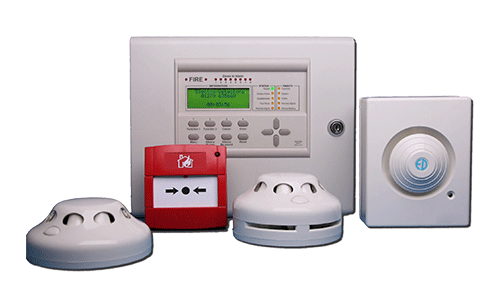
They typically use manual call points (break-glass units) positioned along escape routes and exits, connected to a building-wide alarm system.
Manual systems are often used:
- In low-risk premises
- Where staff are always present
- In conjunction with automatic detection systems
Smaller premises may use simple alert devices, though most commercial buildings integrate manual call points into a Grade A system.
Category L – Life Protection Fire Detection Systems
Category L systems are automatic fire detection systems designed to protect life. They are divided into five levels, offering increasing degrees of coverage.
Category L1 – Maximum Life Protection
The highest level of life protection.
Detectors are installed throughout all areas of the building, including roof voids, service risers, and high-risk rooms, with limited exclusions.
The objective is to provide the earliest possible warning, particularly in:
- Sleeping accommodation
- Complex or large premises
- Buildings with delayed evacuation strategies
Category L2 – Additional Life Protection
Provides automatic detection in:
- All escape routes
- High-risk areas (e.g. kitchens, plant rooms, boiler rooms)
L2 systems are commonly used in:
- HMOs
- Care premises
- Buildings with higher ignition risks
Category L3 – Standard Life Protection
Detectors are installed on:
- Escape routes
- Rooms opening onto escape routes
The aim is to ensure occupants can evacuate safely before escape routes become compromised.
L3 is one of the most commonly specified categories for commercial buildings.
Category L4 – Modest Life Protection
Detection is limited to escape routes and circulation spaces only, such as corridors and stairwells.
Typically suitable for:
- Low-risk premises
- Single-storey buildings
- Offices with simple layouts
Not generally appropriate for complex or multi-storey buildings.
Category L5 – Localised Life Protection
A bespoke system designed to address specific, identified risks within a building.
Often used in conjunction with other categories, for example:
- L4 throughout the building
- L5 detection in a server room or workshop
L5 systems are risk-driven and tailored to the findings of the fire risk assessment.
Category P – Property Protection Systems
Category P systems are designed to protect property and business continuity, rather than life alone.
Category P1 – Maximum Property Protection
Automatic detection is installed throughout the entire building.
P1 systems aim to:
- Detect fires at the earliest possible stage
- Reduce damage
- Minimise business disruption
Often specified where downtime or asset loss would be critical.
Category P2 – Defined Property Protection
Detection is installed only in high-risk or high-value areas, such as:
- Plant rooms
- Storage areas
- Server rooms
P2 systems offer a cost-effective solution, though they do not provide full building coverage.
Choosing the Right Fire Alarm Category
There is no one-size-fits-all solution when it comes to fire alarm categories.
The correct system depends on:
- The nature of your business
- Building layout and use
- Fire risk assessment findings
Legal duties under fire safety legislation
Selecting the wrong category can result in:
- Inadequate life protection
- Enforcement action
- Invalidated insurance
If you need practical help choosing, designing or reviewing a system, see our fire alarm system surveys, design and installation page. For legal duties and maintenance requirements, see our fire alarm regulations guide.
Professional Advice Makes the Difference
Because fire alarm systems play a critical role in life safety and legal compliance, professional advice is essential.
A competent fire alarm specialist can:
- Assess your premises
- Recommend the correct grade and category
- Design a compliant system
- Ensure installation and maintenance meet British Standards
For expert guidance, contact us today about our fire alarm surveys, design, and installation services.
Our Experience With Fire Alarm Categories
At Fire Risk Assessment Network, we regularly advise on fire alarm categories as part of fire risk assessments, system reviews, and fire alarm design discussions across a wide range of UK premises.
In practice, we find that fire alarm categories are often misunderstood or oversimplified. Common issues include:
- categories being selected by default rather than through risk assessment
- inconsistent detector coverage compared to the stated category
- confusion between life protection (L categories) and property protection (P categories)
- systems that no longer reflect changes in building use or layout
Our approach is to treat fire alarm category selection as a risk-based decision, informed by how the building is used, how occupants evacuate, and where fire is most likely to occur. This includes:
- aligning alarm categories directly with fire risk assessment findings
- considering both life safety and business continuity where appropriate
- ensuring category selection can be clearly justified to enforcing authorities and insurers
Across commercial premises, mixed-use buildings, and multi-occupied residential properties, our experience is that fire alarm systems are most effective when the chosen category is proportionate, clearly documented, and kept under review as part of ongoing fire safety management.
Conclusion
Fire alarm categories play a critical role in protecting life, property, and business continuity, but selecting the correct category is not a box-ticking exercise.
In practice, the appropriate fire alarm category should always be determined by a suitable and sufficient fire risk assessment, taking into account how a building is used, how occupants evacuate, and where fire risks are most likely to arise. Systems that are incorrectly categorised, outdated, or no longer aligned with the premises can leave Responsible Persons exposed to enforcement action and unnecessary risk.
Where there is any uncertainty, professional review and advice can help ensure that fire alarm provision is proportionate, defensible, and compliant with current UK fire safety legislation and British Standards.
Frequently Asked Questions About Fire Alarm Categories
What is the difference between a fire alarm grade and a fire alarm category?
Fire alarm grades describe the type and quality of the system, including power supplies and control equipment. Fire alarm categories describe the level and purpose of protection the system provides, such as life protection or property protection. Both are defined within BS 5839 and serve different but complementary roles.
How is the correct fire alarm category determined?
The appropriate fire alarm category should be determined through a suitable and sufficient fire risk assessment. This assessment considers factors such as building use, occupancy, evacuation strategy, fire hazards, and the consequences of fire. Categories should not be selected by default or assumption.
Do all commercial buildings require the same fire alarm category?
No. Fire alarm categories must be proportionate to risk. A small, low-risk office may require a different level of detection compared to a multi-storey, high-occupancy or mixed-use building. The correct category depends on how the premises are used and the risks present.
Can a building have more than one fire alarm category?
Yes. It is common for buildings to use a combination of categories, such as a general life protection system with additional detection in higher-risk areas. For example, a building may operate primarily under one category while applying localised protection elsewhere.
What happens if the fire alarm category is incorrect or outdated?
An incorrectly specified or outdated fire alarm category can result in inadequate protection, increased risk to occupants, and potential enforcement action. It may also affect insurance cover and business continuity. Fire alarm provision should be reviewed whenever building use, layout, or risk changes.
Is a manual fire alarm system sufficient on its own?
In some low-risk premises, a manual system may be acceptable. However, many commercial and higher-risk buildings require automatic fire detection to provide early warning. Whether a manual system alone is suitable must be justified through fire risk assessment.
How often should fire alarm categories be reviewed?
Fire alarm categories should be reviewed as part of regular fire risk assessment reviews, and whenever there are significant changes to the building, occupancy, or activities carried out within the premises.
Last updated