Fire doors are a core part of a commercial building’s passive fire protection—they protect escape routes, maintain compartmentation, and slow the spread of fire and smoke. In the UK, compliance isn’t just about having a “fire door”; it’s about ensuring the correct doors are installed in the correct locations, are self-closing where required, are not compromised, and are maintained so they perform when needed.
If you’re a building owner, facilities manager, duty holder or Responsible Person, this guide explains what “compliant” looks like in practice—plus the checks and actions that reduce legal and life-safety risk.
In summary: In commercial buildings, fire doors protecting escape routes or forming part of compartmentation must be correctly rated, generally self-closing, not wedged open, installed as complete door sets, and subject to regular inspection and maintenance in accordance with UK fire safety legislation and Approved Document B.
Quick Answer
Commercial fire door requirements depend on the building layout, use, escape routes, compartmentation and fire risk assessment. Fire doors should be suitable for their location, kept in efficient working order and maintained so they can protect escape routes and restrict fire and smoke spread.
What UK Rules Apply To Fire Doors In Commercial Premises?
The primary legal framework is the Building Regulations 2010 (as amended), supported by fire safety legislation governing ongoing management and maintenance.
Commercial fire door requirements sit across two key areas:
- Fire safety law and ongoing management (how doors are maintained, used, and kept effective day-to-day)
- Building design standards and guidance (how doors should be specified/installed as part of means of escape and compartmentation)
For commercial buildings, Approved Document B (Volume 2 – buildings other than dwellings) is a primary source of guidance on where fire doors are needed, how they should perform, and expectations such as self-closing and appropriate hold-open methods.
Government fire risk assessment guidance for workplaces (e.g., offices and shops) also highlights poor fire door maintenance and doors being wedged open as common contributors to fire/smoke spread.
Where Are Fire Doors Typically Required In Commercial Buildings?
Fire doors are required wherever they are needed to protect escape routes, maintain fire compartmentation, or separate areas presenting different levels of fire risk within a commercial building.
They are typically required:
- On protected escape routes, such as stairwells and protected corridors
- Between fire compartments to prevent the spread of fire and smoke
- To higher-risk rooms, including plant rooms, electrical intake rooms and storage areas
- Between different uses in mixed-use premises (for example, separating commercial and residential areas)
- To service risers and ducts where fire-resisting separation is necessary
In mixed-use buildings or commercial premises with residential accommodation above, additional considerations may apply. See our guidance on fire door compliance for blocks of flats where relevant.
Your Fire Risk Assessment and the building’s fire strategy should identify which doors are critical to life safety and compartmentation, and confirm the appropriate fire-resistance rating (e.g. FD30 or FD60).
Fire Door Requirements In Different Types Of Commercial Premises
While the underlying legal framework is consistent, fire door requirements vary slightly depending on the building’s use, layout and occupancy risk profile.
- Offices: Fire doors are typically required on protected corridors, stairwells, plant rooms and areas presenting higher fire load. Where offices form part of larger multi-occupancy buildings, compartmentation between tenancies is also critical.
- Warehouses and Industrial Units: Larger compartment sizes, higher fire loads and potential mezzanine levels mean fire doors are often required to protect escape routes, plant rooms and separation between warehouse and office areas.
- Care Homes and Healthcare Premises: Fire doors play a critical role in protecting vulnerable occupants. Compartmentation, corridor protection and reliable self-closing devices are particularly important to support phased evacuation or progressive horizontal evacuation strategies.
- Schools and Educational Buildings: Fire doors are typically required on protected stairwells, corridors and higher-risk rooms such as kitchens and plant rooms. High footfall environments increase the importance of regular inspection and maintenance.
- HMOs and Mixed-Use Buildings: Where commercial premises form part of a building that includes residential accommodation, fire-resisting separation between uses is essential. Additional requirements may apply to flat entrance doors and communal escape routes.
Commercial fire door requirements should be considered through the fire risk assessment, the building layout, escape routes, compartmentation and fire safety management arrangements. For wider legal duties, see our fire door regulations guide.
Need commercial fire doors checked? A fire door inspection can record defects, photographs and priority actions for offices, shops, warehouses, hospitality premises and other commercial buildings.

Fire Door Ratings In Commercial Buildings
Most commercial settings will encounter:
- FD30 (30 minutes)
- FD60 (60 minutes)
The correct rating depends on the building’s fire strategy, compartment size, travel distances, risk profile, and required protection of escape routes. A door’s rating is only meaningful if the full doorset (leaf, frame, seals, glazing, ironmongery, closer, installation) is suitable and maintained.
Do Commercial Fire Doors Need To Be Self-Closing?
In most cases: yes.
Approved Document B (Volume 2 – buildings other than dwellings) states that fire doorsets should be fitted with a self-closing device, with limited exceptions, and also explains the limited circumstances where self-closing doors may be held open using suitable methods.
The practical compliance point
If a fire door that should be self-closing doesn’t reliably close and latch, it is not providing the intended protection of compartmentation or escape routes.
Can Fire Doors Be Held Open In Commercial Buildings?
They can be—but only using compliant methods.
Approved Document B (Volume 2 – buildings other than dwellings) recognises that where self-closing interferes with normal use, self-closing fire doors may be held open by specified methods including automatic release mechanisms activated by a fire detection and alarm system, or a door closer delay device (and other conditions).
What this means in practice
- Wedges are not compliant.
- If a door must be open for access/flow, you typically need an automatic hold-open/release device that releases on alarm so the door closes when it matters.
Improvised solutions such as wedges are not compliant and are a common enforcement issue in commercial premises. You can read more in our guide on why fire doors must not be wedged open.
Government workplace fire guidance explicitly flags fire doors wedged open as a route for fire and smoke spread.
Fire Door Signage Requirements (Commercial)
Approved Document B also references appropriate fire door signage, such as:
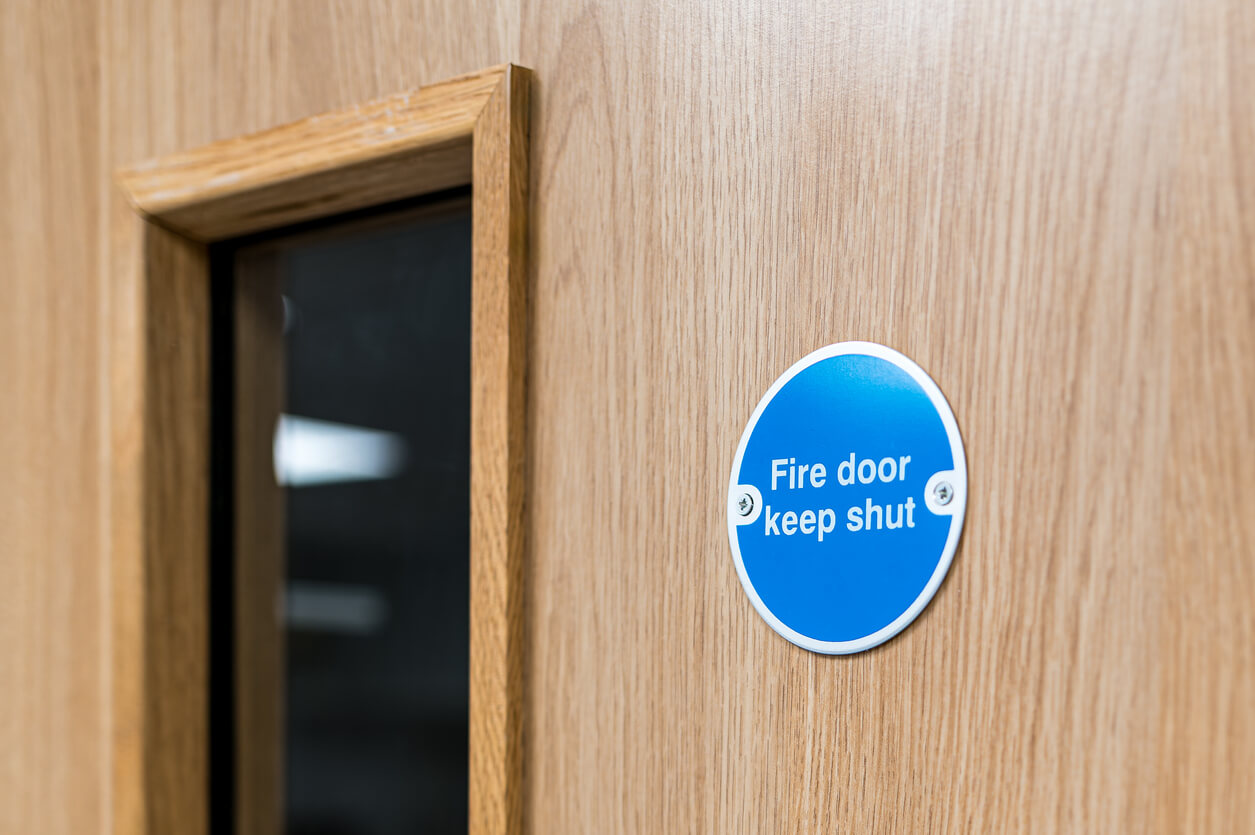
- “Fire door keep shut”
- “Fire door keep locked shut”
- Where held open correctly: signage indicating an automatic fire door / keep clear type instruction (context-dependent)
Signage supports compliance because it sets the expected behaviour—especially in busy premises where doors are frequently used.
What Makes A Fire Door Non-Compliant In Commercial Premises?
Common compliance failures that frequently appear in audits and fire risk assessments include:
- Door does not close fully or latch
- Closer missing, disconnected, or set incorrectly
- Door is wedged open
- Damaged leaf, frame, hinges, glazing, or edge seals
- Missing/painted-over intumescent or smoke seals
- Excessive gaps around the door
- Incorrect/unapproved ironmongery or modifications
- Poor installation (frame not properly fixed/fire-stopped)
Correct fire door installation is essential, as poor fitting or incorrect ironmongery can invalidate a door’s fire-resisting performance.
Because fire doors are “system components”, small defects can materially reduce performance.
If you are unsure whether your doors meet current standards, a professional fire door inspection can identify defects, confirm compliance and provide documented remedial recommendations.
How Often Should Fire Doors Be Inspected In Commercial Buildings?
There isn’t one single inspection interval that applies to every commercial building in legislation, but common UK best practice is:
- Routine in-house checks (often monthly in higher-traffic premises)
- Formal recorded inspections by a competent person at least every 6 months, with more frequent checks in busy or high-risk environments
The Fire Protection Association (FPA) points to best practice guidance that commonly recommends six-monthly checks as a baseline.
If your building has high footfall, vulnerable occupants, or frequent door abuse (schools, healthcare, warehousing, hospitality), you should generally inspect more often.
What Should A Commercial Fire Door Inspection Check?
A practical inspection typically covers:
- Does the door self-close smoothly from any open position?
- Does it fully close and latch into the frame?
- Are hinges, closer, latch/lock, and handles secure and functional?
- Are intumescent/smoke seals present and undamaged?
- Are there signs of warping, impact damage, or alterations?
- Are gaps within acceptable tolerances (consistent and not excessive)?
- Is required signage present and correct?
- Is the door being misused (wedged, hooked, tied back)?
If defects are found, they should be recorded and repaired promptly—especially where the door protects an escape route or compartment line.
What Should a Commercial Fire Door Report Include?
For commercial premises, a useful fire door inspection report should identify each door checked, its location, visible defects, photographs where included, priority actions and any recommended repair or replacement. This helps employers, landlords, facilities managers and responsible persons track remedial work and demonstrate that defects are being managed.
Responsibilities In Commercial Buildings
Under the Regulatory Reform (Fire Safety) Order 2005, the Responsible Person must ensure that fire precautions are maintained in efficient working order and in good repair.
In practical terms, this means ensuring that fire doors are:
- Correctly specified and installed in accordance with the building’s fire strategy
- Kept effective and unobstructed (not wedged open, altered or damaged)
- Fitted with functioning self-closing devices where required
- Subject to regular inspection and maintenance
A fire door that does not close properly, has damaged seals, or is routinely wedged open is unlikely to meet this legal duty.
National fire risk guidance for workplaces makes clear that poorly maintained or wedged fire doors can enable rapid fire and smoke spread.
Failure to maintain fire doors in working order can result in enforcement action, prosecution and significant financial penalties where serious breaches are identified.
For pricing factors, see our fire door inspection cost guide.
Practical Next Steps For Building Owners And Facilities Teams
If you manage a commercial building, a defensible approach is:
- Identify which doors are fire doors (and which are critical for escape routes/compartmentation)
- Implement a recorded inspection regime (frequency matched to use/risk)
- Fix “quick wins” immediately (wedges removed, closers adjusted, doors latching)
- Schedule competent repairs/replacements for damaged doorsets
- Where operational need exists, install compliant hold-open devices that release on alarm
- Keep evidence (logs, photos, remedial actions) to demonstrate management control
Summary Of Fire Door Requirements In Commercial Buildings
In commercial buildings, fire doors form part of the building’s passive fire protection strategy and must be capable of protecting escape routes and maintaining compartmentation in the event of a fire.
In practical terms, compliance requires that fire doors are:
- Correctly located where required by the building’s fire strategy
- Appropriately rated (e.g. FD30, FD60) for their location and risk profile
- Fitted with functioning self-closing devices where required
- Not wedged open or altered in a way that compromises performance
- Properly installed as complete door sets
- Regularly inspected and maintained so they fully close and latch
- Supported by suitable signage where applicable
A fire door only provides protection if it is able to close and perform as tested. Even minor defects — such as damaged seals, excessive gaps or faulty closers — can undermine compliance and increase risk.
For commercial premises, demonstrating control through inspection records, maintenance logs and corrective action is just as important as having the correct doors in place.
Conclusion
Commercial fire door compliance is about performance, not labels. Doors must be correctly specified, self-closing where required, properly maintained and effectively managed.
If you are unsure whether your commercial premises meet current requirements, a professional fire risk assessment and fire door inspection can provide clarity, documentation and defensible compliance.
Frequently Asked Questions
Are Fire Doors Required In Commercial Buildings In The UK?
Yes. In most commercial buildings, fire-resisting doors are required to protect escape routes and maintain fire compartmentation. The exact requirement depends on the building’s layout, use and fire strategy, but most offices, shops, warehouses, schools and mixed-use premises will require fire doors in key locations.
Do Fire Doors In Commercial Buildings Have To Be Self-Closing?
In most cases, yes. Fire doors that protect escape routes or form part of compartmentation are normally required to be fitted with a self-closing device. This ensures the door closes automatically after use and can perform properly in the event of a fire.
Is It Illegal To Wedge A Fire Door Open In A Commercial Premises?
Yes. Wedging a fire door open prevents it from closing and undermines its fire-resisting function. This can breach fire safety duties and may be identified as a significant finding during inspection or fire risk assessment. Only approved hold-open devices linked to the fire alarm system are acceptable where doors need to remain open during normal use.
Are Hold-Open Devices Allowed On Commercial Fire Doors?
Yes, but only where properly specified and installed. Fire doors may be held open using compliant automatic release mechanisms that activate when the fire alarm operates. Improvised methods such as wedges, hooks or furniture are not acceptable.
How Often Should Commercial Fire Doors Be Inspected?
Fire door inspection frequency should be risk-based. As a general best practice in commercial premises, formal inspections are often carried out at least every six months, with more frequent checks in high-traffic or higher-risk environments. Routine in-house checks should also form part of ongoing fire safety management.
What Happens If A Commercial Fire Door Does Not Close Properly?
If a fire door does not fully close and latch, it may fail to contain fire and smoke. This compromises escape routes and compartmentation and should be treated as a priority maintenance issue. Doors protecting stairwells and protected corridors are particularly critical.
Last updated