Fire doors and fire exit doors are frequently confused — but they are not the same thing.
They serve different roles within a building’s overall fire safety strategy and are designed for different life-safety purposes under UK fire safety legislation.
In simple terms:
- A fire door is designed to resist the spread of fire and smoke.
- A fire exit door is designed to enable safe and immediate escape from a building.
Both are essential, but they perform distinct functions. Misunderstanding the difference can lead to compliance failures, enforcement action, or compromised safety.
If you are a Responsible Person, landlord, managing agent or facilities manager, understanding which doors must contain fire — and which must allow escape — is critical for legal compliance and risk management.
Quick Answer
A fire door is designed to resist fire and smoke spread for a specified period. A fire exit door is designed to allow safe escape from a building. Some doors may serve both functions, but they are not automatically the same thing.
What Is a Fire Door?
A fire door is a specially constructed door set designed to resist the passage of fire and smoke for a specified period — typically:
- FD30 – 30 minutes fire resistance
- FD60 – 60 minutes fire resistance
Fire doors are part of a building’s compartmentation strategy, helping to:
- Protect escape routes
- Slow fire spread
- Reduce smoke movement
- Protect property and structural integrity
Key Features of a Fire Door
A compliant fire door set typically includes:
- Fire-rated door leaf
- Certified door frame
- Intumescent strips
- Smoke seals
- Self-closing device
- Fire-rated hinges and hardware
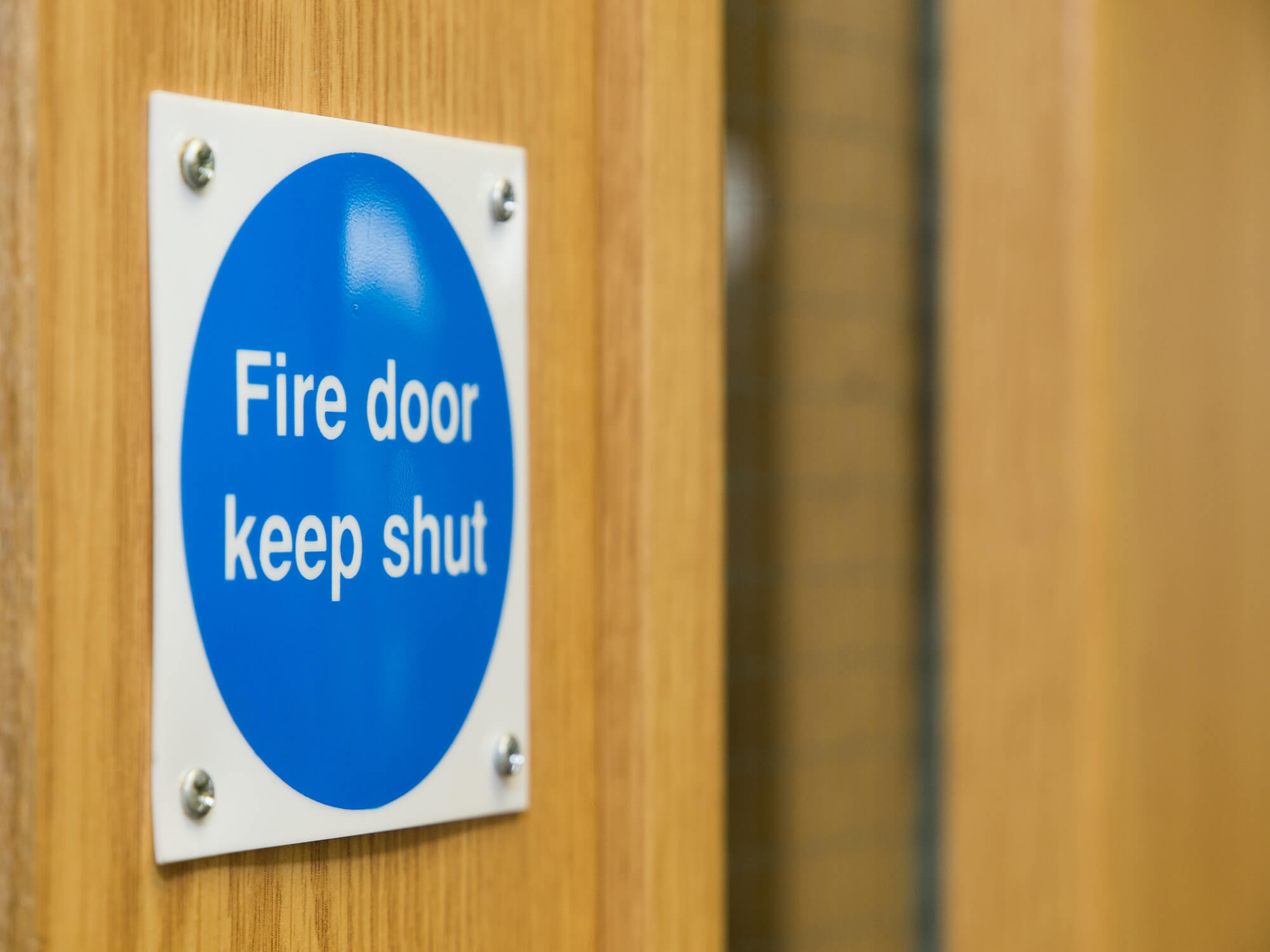
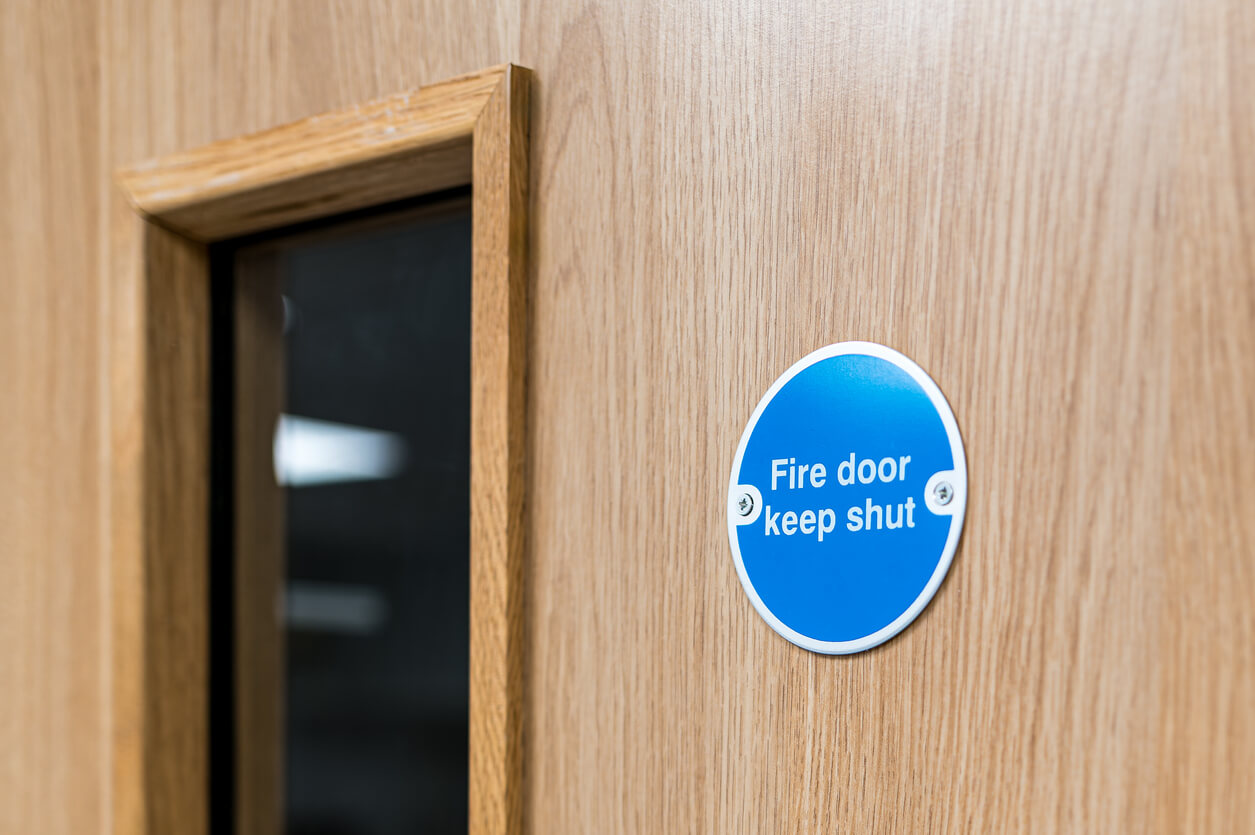
- Appropriate signage (where required)
Fire doors are installed in:
- Corridors
- Stairwells
- Plant rooms
- Communal areas
- Flat entrance doors in blocks of flats
- Commercial kitchens and high-risk rooms
They must be properly installed and maintained to remain compliant under the Regulatory Reform (Fire Safety) Order 2005 and the Fire Safety (England) Regulations 2022.
What Is a Fire Exit Door?
A fire exit door (sometimes called an emergency exit door) is a door that provides a means of escape from a building during an emergency.
Its primary function is safe evacuation, not fire resistance.
Fire exit doors:
- Lead directly to a place of safety (usually outside)
- Open in the direction of escape (where required)
- Must be easily and immediately openable without a key
- Often include panic bars or push-pad hardware
They are commonly found:
- At the final exit of a building
- At the end of escape corridors
- In commercial premises
- In schools, offices, warehouses and public buildings
A fire exit door does not automatically mean the door is fire-resisting.
Some fire exit doors are also fire doors — but many are simply outward-opening escape doors without a fire rating.
Panic Hardware and Emergency Exit Standards in the UK
In many commercial and public buildings, fire exit doors must be fitted with appropriate panic or emergency exit hardware to ensure they can be opened immediately and without a key.
In the UK, this is typically governed by:
- BS EN 1125 – Panic exit devices (push bars), used where the public may be present
- BS EN 179 – Emergency exit devices (push pads or lever handles), used where occupants are familiar with the building
Fire exit doors must:
- Open easily in the direction of escape where required
- Not require a key, code or specialist knowledge to operate
- Be free from obstruction
- Remain unlocked when the building is occupied
Incorrect hardware — or locked final exits — is a common cause of enforcement action.
Where a door is both a fire door and a fire exit door, the hardware must be compatible with the fire-resisting door set and correctly certified.
Fire Door vs Fire Exit Door: The Key Differences
| Feature | Fire Door | Fire Exit Door |
|---|---|---|
| Main Purpose | Contain fire and smoke | Allow escape |
| Fire Resistance Rating | Yes (FD30, FD60 etc.) | Not always |
| Self-Closing | Usually required | Not typically |
| Opens Outwards | Not always | Usually required |
| Location | Internal compartments | Final exit or escape route |
| Part of Compartmentation | Yes | Not necessarily |
The confusion often arises because:
- A door on an escape route may be both a fire door and a fire exit door
- Signage can use the term “Fire Exit” even when the door is fire-resisting
This is why professional fire risk assessment is important.
Both fire doors and fire exit doors can be important to escape and compartmentation, but they serve different purposes. Where doors form part of a fire safety strategy or escape route, defects should be considered during a fire door inspection or fire risk assessment review.
For legal duties, see our fire door regulations guide.
Can a Door Be Both a Fire Door and a Fire Exit Door?
Yes — but not always.
For example:
- A door protecting a stairwell may be a fire-resisting door that also forms part of an escape route.
- A final exit door may be a non-fire-rated outward opening door with panic hardware.
Whether a door requires fire resistance depends on:
- Building layout
- Occupancy type
- Travel distances
- Compartmentation strategy
- Fire risk assessment findings
Incorrectly assuming all exit doors are fire doors (or vice versa) can result in compliance failures.
How the Difference Applies in Different Building Types
The distinction between fire doors and fire exit doors becomes particularly important depending on the building type.
In Blocks of Flats
In purpose-built blocks of flats:
- Flat entrance doors are typically fire-resisting (FD30S) and form part of the building’s compartmentation strategy.
- Communal corridor doors protecting stairwells are usually fire doors.
- Final exit doors from the building may be fire exit doors — and may or may not require a fire rating depending on the fire strategy.
Under the Fire Safety (England) Regulations 2022, Responsible Persons must carry out routine checks of communal fire doors and annual checks of flat entrance doors.
Confusing flat entrance fire doors with standard doors is a common compliance issue.
In Commercial Buildings
In offices, shops, warehouses and public premises:
- Internal doors protecting escape corridors are often fire doors.
- Final exit doors must allow immediate escape and may require panic hardware.
- High-occupancy buildings (e.g. retail or assembly spaces) typically require panic bars compliant with BS EN 1125.
Fire exit doors in these settings must never be locked in a way that prevents immediate escape during occupation.
In Care Homes and Higher-Risk Premises
In buildings with vulnerable occupants:
- Fire doors are critical for progressive horizontal evacuation strategies.
- Doors may need additional smoke seals or automatic closing devices.
- Escape door usability must be carefully balanced with security measures.
This is why fire door and escape route design must always align with the building’s fire strategy and fire risk assessment.
What Does UK Law Require?
Under the Regulatory Reform (Fire Safety) Order 2005, the Responsible Person must:
- Ensure safe means of escape
- Maintain fire protection measures
- Keep escape routes clear and usable
- Ensure fire doors are maintained in efficient working order
The Fire Safety (England) Regulations 2022 introduced additional duties in multi-occupied residential buildings, including:
- Routine checks of communal fire doors
- Annual checks of flat entrance doors
Failure to correctly identify which doors are fire doors and which are escape doors can lead to enforcement action.
Fire authorities can issue enforcement notices or prosecute where fire doors or escape routes are non-compliant.
How Often Should Fire Doors Be Checked?
Maintenance is just as important as installation.
Under UK fire safety legislation:
- Fire doors must be maintained in efficient working order.
- In buildings over 11 metres in height, communal fire doors must be checked at least every 3 months.
- Flat entrance doors in such buildings must be checked at least annually (where access is permitted).
In other non-domestic premises, inspection frequency should be determined by risk assessment — but regular documented checks are considered best practice.
Fire exit doors must also be routinely checked to ensure:
- They open easily
- Panic hardware functions correctly
- No obstructions are present
- They have not been improperly locked
Failure to maintain fire doors or escape doors can result in enforcement notices, prosecution and significant fines.
Common Compliance Mistakes
During fire door inspections, we frequently see:
- Fire doors wedged open
- Fire exit doors locked or obstructed
- Incorrect signage
- Missing self-closers
- Non-certified replacement doors
- Flat entrance doors replaced with non-fire-rated doors
These issues can invalidate compartmentation and compromise evacuation safety.
How Do You Know Which Doors Must Be Fire Rated?
The only reliable way is through a suitable and sufficient fire risk assessment, which considers:
- Building use
- Occupancy vulnerability
- Escape strategy (stay-put vs simultaneous evacuation)
- Compartmentation layout
- Existing door certification
A professional assessor will identify:
- Which doors must be fire-resisting
- Which doors must function as fire exits
- Where upgrades or replacement are required
Why This Matters for Those Responsible for Residential Buildings
If you manage:
- Blocks of flats
- HMOs
- Commercial premises
- Care homes
- Offices
- Mixed-use buildings
You are legally responsible for ensuring both:
- Effective fire compartmentation
- Safe means of escape
Confusing fire doors with fire exit doors is a common compliance gap — particularly in older buildings where doors have been replaced over time without certification.
Fire Door and Fire Exit Door Inspections
At Fire Risk Assessment Network, we provide:
- Fire door inspections
- Compliance reviews
- Replacement advice
- Flat entrance door assessments
- Compartmentation surveys
- Full fire risk assessments
We help Responsible Persons understand exactly what their building requires — proportionately and in line with UK legislation.
Conclusion
A fire door and a fire exit door are not the same thing — although in some cases a door may serve both functions.
- Fire doors protect life by containing fire and smoke.
- Fire exit doors protect life by enabling escape.
Both are essential, but they must be correctly identified, installed and maintained to remain legally compliant.
If you are unsure whether your doors meet UK fire safety requirements, a professional assessment can provide clarity and defensible compliance.
Frequently Asked Questions
Is a fire exit door the same as a fire door?
No. A fire door is designed to resist fire and smoke for a set period (e.g., FD30/FD60). A fire exit door is designed to help people escape quickly and safely. Some doors can be both, but many fire exit doors are not fire-rated.
Does a fire exit door need a fire rating in the UK?
Not always. A final exit door often only needs to be easy to open, unobstructed, and suitable for escape. Whether it also needs a fire rating depends on the fire strategy, compartmentation, and what the fire risk assessment identifies.
Can one door be both a fire door and a fire exit door?
Yes. For example, a door on an escape route might need to be fire-resisting (to protect the route) and also allow escape. The exact requirement depends on the building layout and escape strategy.
Do fire doors have to be self-closing?
In most cases, yes. Fire doors usually require a self-closing device so the door is closed in normal use and can contain fire/smoke if a fire occurs.
What’s the difference between a “fire door” and an “emergency exit door”?
A fire door is about containment (fire/smoke). An emergency exit door is about evacuation (getting people out). The terms are often mixed up, which is why door roles should be confirmed by risk assessment.
Are flat entrance doors fire doors?
In many blocks of flats, flat entrance doors are part of the building’s compartmentation and are typically fire-resisting (commonly FD30S). The correct specification should be confirmed from the building’s design/strategy and your fire risk assessment.
Can I replace a fire door with a standard door?
No. Replacing a fire door with a non-fire-rated door can compromise compartmentation and may create a compliance issue. Any replacement should be a certified fire door set installed correctly.
How do I know which doors must be fire doors in my building?
The reliable way is a suitable and sufficient fire risk assessment and/or review of the building’s fire strategy. This identifies which doors are required to be fire-resisting and what maintenance/inspection regime applies.
Last updated